AI Threat Tracker at a glance
Google's GTIG AI Threat Tracker, published November 16, 2026, reports the first observed LLM framework, exploit_agent, fully automating vulnerability discovery and exploitation. Zero-day exploits spiked to 22 in August 2026; LLMJacking charges exceeded $100,000 in a single day.
Ask your AI about this story
Use this story in your business: Google GTIG AI Threat Tracker: exploit_agent automates vulnerability exploitation with no human in the loop (Google). Ask your AI to explain what happened, how it could affect your business and how to put it to work. It also weighs price, speed, intelligence and the lab behind it. The link to the story is included.
AI Threat Tracker: status
- Affected
- Internet-facing web applications: agentic frameworks compare code before and after patches and turn newly fixed (n-day) flaws into working exploits automatically, shrinking the safe patch window to days
- PaperCut NG/MF print servers: CVE-2026-81578 and CVE-2026-82078 were exploited as zero-days, with LLM-assisted exploits within a day and a campaign against hundreds of organizations (August 2026)
- Cloud and LLM accounts: stolen API keys and session tokens power LLMJacking resale through LLM Mixers, with single-day fraudulent charges above $100,000 and up to $1 million cumulatively in the worst cases
- Developer machines with AI coding assistants: attackers modify agent configuration files (for example .claude/settings.json) so starting the tool downloads a backdoor
- Last checked
What changed with AI Threat Tracker
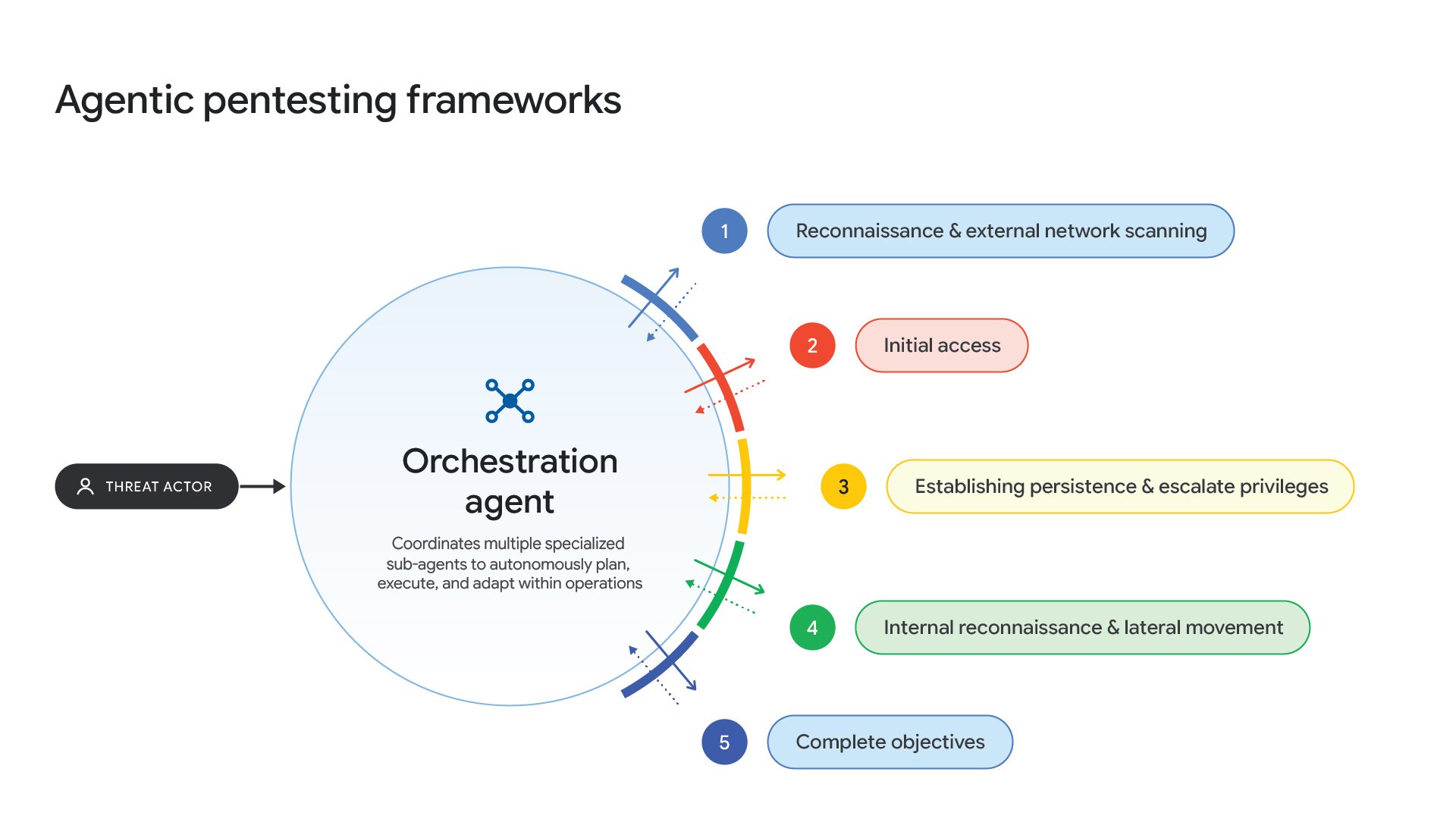
On November 16, 2026, Google Threat Intelligence Group (GTIG) and Mandiant published the latest GTIG AI Threat Tracker, reporting that attackers used LLM frameworks to fully automate vulnerability discovery and exploitation without a human in the loop for the first time. On an exposed staging server, GTIG found exploit_agent, a multi-agent framework wired to frontier and local LLMs that continuously compares popular web application code before and after patch announcements, identifies likely vulnerabilities, drafts exploits and executes them on its own; its operator targeted French media, entertainment and education websites. The report also confirms live intrusion use of the open-source agentic pentesting frameworks ARTEX, CAIRN and PentAGI, with experimentation in CyberStrikeAI and HexStrike AI.
The figures show the patch window collapsing: overall vulnerability disclosures and exploits nearly doubled between January and August 2026, and zero-day exploits rose from a 2025 average of 8 per month to 11 per month in 2026 before spiking to 22 in August. In late August, two PaperCut NG/MF flaws (CVE-2026-81578 and CVE-2026-82078) were exploited as zero-days, LLM-assisted exploits appeared within a day, and a follow-on campaign hit hundreds of organizations, reaching domain administrator within minutes. Monetization is scaling too: LLMJacking — stealing cloud and LLM credentials to resell access through LLM Mixers — generated single-day fraudulent charges above $100,000 and up to $1 million cumulatively in the worst cases. Google SecOps has deployed rulepacks to detect ARTEX, and Mandiant released a hardening guide against LLM-enabled offensive tooling.
How to fix it: AI Threat Tracker
1. Update
Patch internet-facing applications as soon as fixes ship: automated patch comparison now yields working exploits within days, so a monthly patch cycle leaves patched (n-day) flaws exposed.
cloud.google.com (opens in a new tab)2. Configuration
Apply Mandiant's hardening guide and architectural defense framework for LLM-enabled offensive tooling, and enable the Google SecOps rulepacks built to detect ARTEX use.
cloud.google.com (opens in a new tab)3. Monitor
Monitor cloud and LLM bills and API usage for LLMJacking: alert on sudden usage spikes, unknown service accounts and quota increases, and rotate exposed API keys and session tokens at once.
cloud.google.com (opens in a new tab)4. Configuration
Audit AI coding assistant configuration files (for example .claude/settings.json) and repositories for tampering before developers start the tools; attackers plant backdoor downloads in them.
cloud.google.com (opens in a new tab)
Advisories
- GTIG AI Threat Tracker: Agentic Threat Activity Crosses a Significant Threshold — Google Cloud Blog (November 16, 2026) (opens in a new tab)cloud.google.com
- The Rise of LLMJacking: How Threat Actors Monetize Compromised Cloud and Model Resources — Google Cloud Blog (opens in a new tab)cloud.google.com
AI Threat Tracker in numbers
Values are copied from the linked source on the date shown. They are not IA Compa measurements.
- Zero-day exploits in August 2026 (GTIG count)as of · Source for Zero-day exploits in August 2026 (GTIG count): cloud.google.com (opens in a new tab)
- 22
- LLMJacking fraudulent charges in a single day, exceeded (USD)as of · Source for LLMJacking fraudulent charges in a single day, exceeded (USD): cloud.google.com (opens in a new tab)
- $100,000+
- LLMJacking cumulative resource abuse in the worst cases (USD)as of · Source for LLMJacking cumulative resource abuse in the worst cases (USD): cloud.google.com (opens in a new tab)
- $1,000,000
Why AI Threat Tracker matters for businesses
Why it matters: the time between a patch shipping and a working exploit is now measured in days or hours, so businesses should patch internet-facing applications immediately on release rather than on a monthly cycle, and use Mandiant's hardening guide and the SecOps detections as a checklist for their own environments. Finance and IT teams should also audit cloud and LLM bills and API keys for LLMJacking — sudden usage spikes, unknown service accounts, charges above $100,000 in a day — and rotate any exposed keys. Teams that use AI coding assistants should review agent configuration files before launch, because attackers now booby-trap them to drop backdoors on developer machines.
Get AI News by email
Verified AI stories, each with its official source, on Monday and Thursday mornings. Add breaking news to hear about the biggest ones as soon as we publish them.
Every story links its official source
Free, in English or Spanish
Unsubscribe with one click, any time
Sources for this story
- GTIG AI Threat Tracker: Agentic Threat Activity Crosses a Significant Threshold (opens in a new tab)Official
Google Threat Intelligence Group · cloud.google.com
- The Rise of LLMJacking: How Threat Actors Monetize Compromised Cloud and Model Resources (opens in a new tab)Official
Google Threat Intelligence Group · cloud.google.com
Last verified: . IA Compa summarizes public announcements for business readers. We are not affiliated with the companies mentioned. Always confirm details, pricing, and availability with the official source.
- #gtig
- #ai-threat-tracker
- #exploit-agent
- #llmjacking
- #artex
- #cairn
- #pentagi
- #zero-day
- #security