MedChemBench at a glance
OpenAI introduced MedChemBench on November 20, 2026: 99 problems drawn from 117 papers and patents that test whether AI models can read molecular structures and predict compound behavior. At the xhigh setting, GPT-6.2 Astra earned 84.5% of the available credit.
Ask your AI about this story
Ask what changed in MedChemBench and what to check before using it in your business. Explain what the benchmark measures, what it does not, and whether the result should change which model or tool I pick.
What changed with MedChemBench
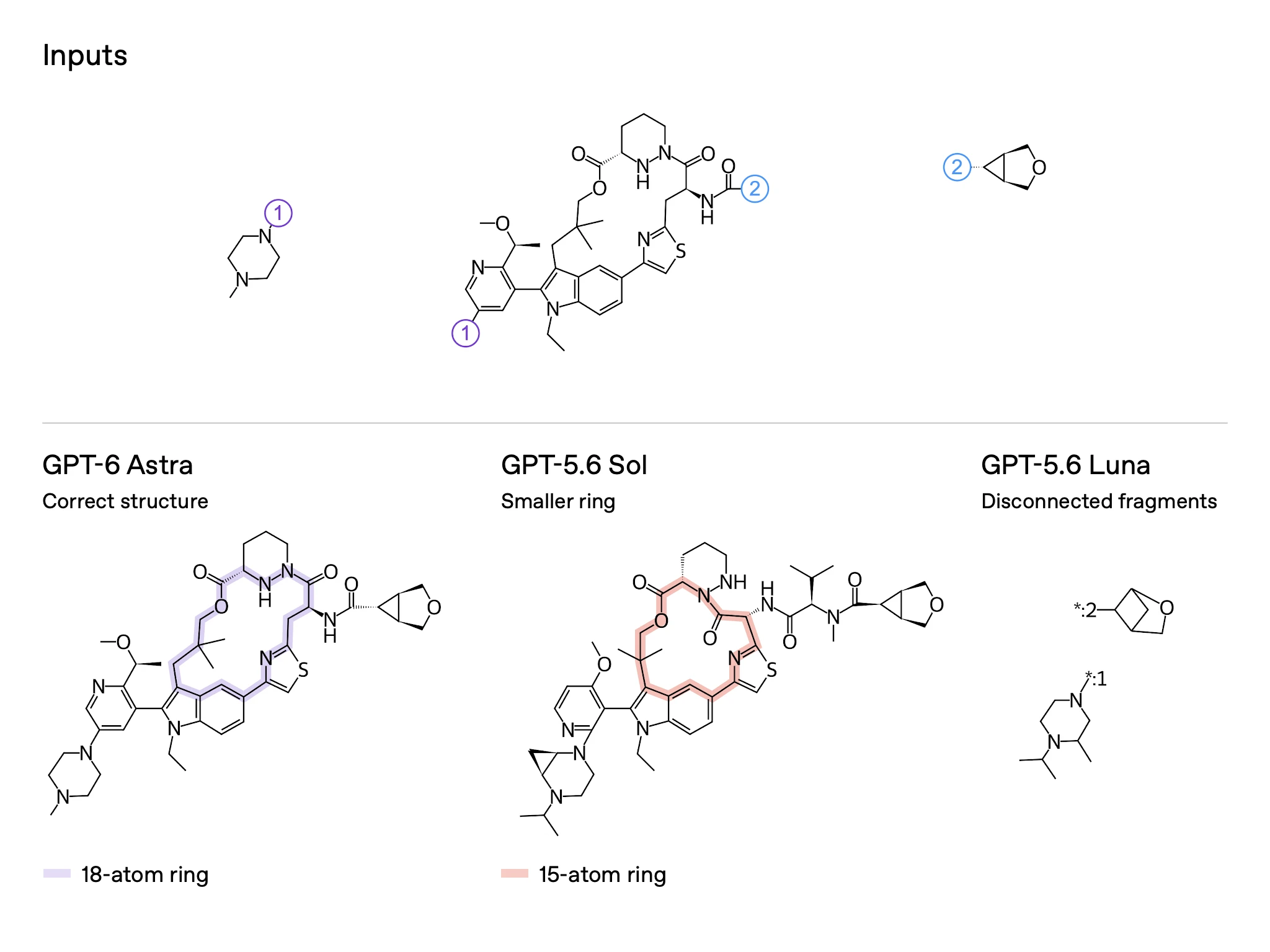
OpenAI introduced MedChemBench on November 20, 2026, a benchmark that evaluates how well AI models reason about medicinal chemistry: connecting a molecule's structure with experimental evidence to explain results, compare compounds and predict their properties in early drug discovery. Its 99 problems are drawn from 117 published papers and patents and cover 761 distinct molecular structures, graded on structure reconstruction, scientific reasoning, ranking and selection, and property prediction.
OpenAI evaluated eleven GPT models at several reasoning-effort settings. At the xhigh setting, according to OpenAI, GPT-6.2 Astra earned 84.5% of the available credit, ahead of GPT-6 Astra at 83.3%, GPT-6.1 Sol at 82.0% and GPT-5.6 Sol at 58.2%; GPT-6 Astra earned 95.4% of the structure credit at xhigh, while compound selection and numerical property prediction earned only about half of the available credit. OpenAI states the limits plainly: the results do not establish that models can discover new drugs or improve laboratory decisions, prior exposure to the published sources cannot be ruled out, and each response was a single attempt without tools, feedback or new experiments.
MedChemBench in numbers
Values are copied from the linked source on the date shown. They are not IA Compa measurements.
- MedChemBench score, GPT-6.2 Astra at xhigh (OpenAI's evaluation)as of · Source for MedChemBench score, GPT-6.2 Astra at xhigh (OpenAI's evaluation): openai.com (opens in a new tab)
- 84.5%
- MedChemBench score, GPT-6 Astra at xhigh (OpenAI's evaluation)as of · Source for MedChemBench score, GPT-6 Astra at xhigh (OpenAI's evaluation): openai.com (opens in a new tab)
- 83.3%
Why MedChemBench matters for businesses
Why it matters: drug-discovery and biotech teams choosing AI assistants for research work gain a public, task-level yardstick for the exact skill the job needs — reading a molecule and weighing tradeoffs between potency, absorption and breakdown — instead of general science scores. Businesses in any field can copy the pattern: test a model on problems drawn from your own industry's published work before trusting it, and note where OpenAI's own results are weakest, in selecting compounds and predicting numbers, before letting an agent make selection or forecasting decisions unsupervised.
Put it to work: AI services
Get AI News by email
Verified AI stories, each with its official source, on Monday and Thursday mornings. Add breaking news to hear about the biggest ones as soon as we publish them.
Every story links its official source
Free, in English or Spanish
Unsubscribe with one click, any time
Sources for this story
- Can AI help scientists identify promising drug candidates? Introducing MedChemBench (opens in a new tab)Official
OpenAI · openai.com
Last verified: . IA Compa summarizes public announcements for business readers. We are not affiliated with the companies mentioned. Always confirm details, pricing, and availability with the official source.
- #openai
- #medchembench
- #medicinal-chemistry
- #drug-discovery
- #benchmark
- #life-sciences