Sous Labs Songe at a glance
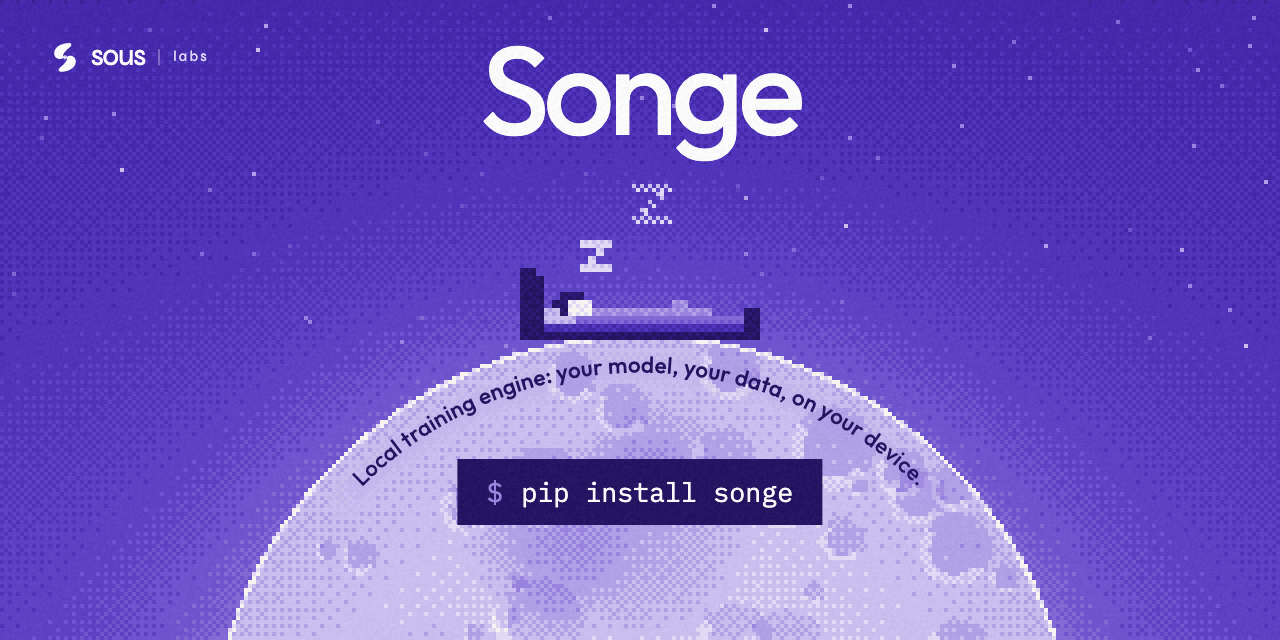
Sous Labs released Songe on November 20, 2026, an open-source local training engine (Apache-2.0) whose Dreams read your past conversations, corrections and tool errors, turn them into practice data, and fine-tune your local model while the machine sits idle; nothing ever leaves your device.
Ask your AI about this story
Ask what changed in Songe and what to check before using it in your business. Weigh pricing, how it connects to the tools I already use, setup effort and whether it replaces something I pay for today.
What changed with Sous Labs Songe
Songe, released by Sous Labs on November 20, 2026, is an open-source local training engine that sits between a coding agent such as opencode or pi and a locally served model from LM Studio, vLLM, Ollama, llama.cpp or mlx-lm. As you work, Songe records what happens after each of the model's actions — the tool result, the error, your next message — and when the agent goes quiet it runs a Dream: a Quick Dream adds your stated preferences to the model's instructions in minutes, while a Deep Dream writes practice data from those lessons and trains the model itself while you are away.
A Deep Dream never trains on your real conversations: for each lesson — a correction, a stated rule, a retry, a tool error — the model writes short practice scenes in your agent's own tools, and the model as it was, shown the lesson, teaches the same model fitted with a small adapter (on-policy distillation), rehearsing earlier skills so they stay. Before a new version is used, it answers at the moments you reacted to and is adopted only if it does clearly better than the version in place without breaking what already worked, and any earlier version can be restored. Songe runs only when the agent is idle, memory is free and the battery is fine, and it keeps no account, telemetry or cloud copy.
Songe is early alpha software: version 0.1.0a13 was published on PyPI on November 20, 2026 under the Apache-2.0 license, and it installs with pip, uv or Homebrew on Python 3.11 or later. Training runs on Apple Silicon (MLX) and on NVIDIA and AMD GPUs (PyTorch); machines without a GPU can serve and record but do not train. Artificial Analysis had not published a page for Songe as of November 21, 2026, so the item carries no benchmark metrics.
Where to compare Sous Labs Songe
Independent leaderboards and official resources for comparing this model yourself. Rankings change often; each site shows its own current data.
Why Sous Labs Songe matters for businesses
Why it matters: a small business or a solo developer can let the model it already runs locally improve overnight from the day's real support chats and coding sessions, instead of sending those conversations to a cloud provider or paying for a bigger hosted model. Because the training data never leaves the machine, the workflow fits client work and data that cannot be uploaded, and the version checks mean a bad night of learning can be rolled back rather than shipped to customers.
Put it to work: AI services
Get AI News by email
Verified AI stories, each with its official source, on Monday and Thursday mornings. Add breaking news to hear about the biggest ones as soon as we publish them.
Every story links its official source
Free, in English or Spanish
Unsubscribe with one click, any time
Sources for this story
- Songe — Sous Labs (opens in a new tab)Official
Sous Labs · souslabs.ai
- sous-labs/songe — GitHub repository (opens in a new tab)Official
Sous Labs · github.com
- songe — PyPI (opens in a new tab)Official
Sous Labs · pypi.org
Last verified: . IA Compa summarizes public announcements for business readers. We are not affiliated with the companies mentioned. Always confirm details, pricing, and availability with the official source.
- #sous-labs
- #songe
- #fine-tuning
- #local-models
- #open-source
- #continual-learning
- #ai-agents
- #dreams